How AI Is Changing Crypto Market Education
Artificial intelligence is reshaping the way people learn about cryptocurrency markets. From real-time pattern recognition to privacy-first on-device analysis, AI crypto trading education is making complex market concepts accessible to everyone.
The Intersection of AI and Crypto Education
The cryptocurrency market has grown into a multi-trillion-dollar ecosystem, attracting millions of newcomers every year. Yet the learning curve remains steep. Understanding candlestick charts, technical indicators, market cycles, and risk management requires time, patience, and the right tools. This is where artificial intelligence steps in to reshape AI crypto trading education from the ground up.
Traditional approaches to learning crypto markets relied heavily on textbooks, online courses, and trial-and-error. Students would study theoretical concepts in isolation and then struggle to apply them to live, fast-moving charts. AI changes this dynamic fundamentally. Instead of learning in a vacuum, students can now interact with intelligent systems that analyze real market data in real time, identify patterns as they form, and explain what those patterns mean in plain language.
The convergence of machine learning and cryptocurrency education is not just a technological novelty. It represents a meaningful shift in how financial literacy can be distributed. Rather than depending on expensive courses or questionable social media influencers, learners can turn to AI-powered educational tools that provide objective, data-driven explanations without the bias that comes from someone trying to sell a position.
The demand for AI crypto trading education is growing rapidly, and for good reason. Cryptocurrency markets operate 24 hours a day, seven days a week, across hundreds of exchanges worldwide. No human instructor can provide real-time guidance around the clock, but an AI-powered learning assistant can be available whenever a student opens a chart.
How Machine Learning Reads Chart Patterns
At the heart of AI-powered crypto education lies pattern recognition, one of the areas where machine learning truly excels. Chart patterns such as head and shoulders, double tops and bottoms, triangles, wedges, and flags have been studied by technical analysts for decades. These patterns are visual by nature, which makes them a natural fit for computer vision and neural network-based analysis.
Machine learning models trained on historical price data can learn to identify these patterns with remarkable consistency. A convolutional neural network, for example, can process a candlestick chart the same way it would process any image, detecting edges, shapes, and structural formations that correspond to known technical patterns. Once identified, the model can label the pattern and provide an educational explanation of what it historically signifies.
Beyond classical chart patterns, machine learning can also detect subtler statistical relationships in market data. Models can analyze the interplay between price, volume, and momentum across multiple timeframes simultaneously, something that would take a human analyst considerable time and effort to do manually. This multi-dimensional analysis helps learners understand that markets are driven by complex interactions, not just single indicators in isolation.
Key Technical Indicators and AI
AI models are particularly effective at teaching learners how to interpret technical indicators in context. Rather than simply displaying a Relative Strength Index (RSI) value on a chart, an AI system can explain what that value means given current market conditions, how it compares to historical norms for that specific asset, and what other indicators suggest when viewed together.
This contextual analysis extends to indicators such as Moving Average Convergence Divergence (MACD), Bollinger Bands, volume-weighted average price (VWAP), and Fibonacci retracement levels. Each of these tools produces more meaningful insights when interpreted alongside other data points, and AI can synthesize those connections far more quickly than manual study allows.
On-Device AI vs. Cloud-Based AI: The Privacy Advantage
Learn faster with AI-powered chart explanations
ChartScope explains every indicator, pattern, and signal on your charts — in plain language, on your iPhone. On-device ML. 9 languages. No trading signals.
Try ChartScope Free for 3 Days →One of the most important distinctions in AI crypto trading education is where the AI model actually runs. Most AI services today operate in the cloud: your data gets sent to a remote server, the model processes it, and the result is sent back. While this approach is powerful, it raises significant privacy and security concerns, especially when financial data is involved.
On-device AI takes a fundamentally different approach. The machine learning model runs entirely on your local device, whether that is a smartphone, tablet, or laptop. Your market data, portfolio information, and analysis results never leave your hardware. There is no server to breach, no data in transit to intercept, and no third-party entity with access to your financial activity.
Why Privacy Matters in Financial Education
When you are learning about crypto markets, you are often working with real portfolio data, real exchange connections, and real API credentials. Sending this information to a cloud service introduces unnecessary risk. Even well-intentioned cloud providers can experience data breaches, and the financial sector is one of the most targeted industries for cyberattacks.
On-device processing eliminates this attack vector entirely. Your API keys stay encrypted in secure hardware storage. Your portfolio balances never appear on an external server log. The AI model analyzes your data locally and produces results that exist only on your device. For privacy-conscious learners, this is not a minor convenience but a fundamental requirement.
On-Device vs. Cloud AI: Key Differences
- Privacy: On-device processing keeps all your data local. Cloud AI requires transmitting data to external servers.
- Latency: On-device analysis produces instant results with no network delay. Cloud AI depends on internet speed and server load.
- Availability: On-device models work offline after initial setup. Cloud AI requires a constant internet connection.
- Security: On-device models have no server-side attack surface. Cloud AI introduces additional security considerations.
- Cost: On-device inference has no per-request cost. Cloud AI services often charge based on usage volume.
Key AI Features in Modern Crypto Learning Apps
The current generation of AI-powered crypto education tools offers a range of features that were impossible just a few years ago. Understanding these capabilities helps learners choose tools that genuinely accelerate their education rather than simply adding complexity.
Real-Time Pattern Recognition
AI models can continuously scan chart data and identify known technical patterns as they develop. Rather than waiting for a pattern to complete and then recognizing it in hindsight, a well-trained model can flag emerging formations early and explain their potential significance. This teaches learners to spot patterns in real time, a critical skill for anyone studying technical analysis.
Natural Language Explanations
Raw data and indicator values are meaningless without context. The best AI learning tools translate numerical analysis into clear, readable explanations. Instead of presenting "RSI: 72," an AI assistant might explain that the RSI is in overbought territory, what that has historically meant for this particular asset, and how it relates to other current indicator readings. This bridges the gap between data and understanding.
Adaptive Learning Paths
Machine learning can track which concepts a student has mastered and which areas need more attention. By analyzing how a learner interacts with charts, which indicators they use, and what questions they ask, an AI system can tailor its explanations to the individual. Beginners receive foundational explanations while more advanced users get deeper technical analysis, all from the same tool.
Multi-Timeframe Analysis
One of the hardest concepts for crypto beginners to grasp is that a single asset can simultaneously show bullish signals on one timeframe and bearish signals on another. AI can analyze multiple timeframes at once and explain how short-term and long-term trends relate to each other, teaching learners to develop a more nuanced market perspective.
The Role of Apple Core ML in On-Device Analysis
Apple Core ML has become a cornerstone of on-device AI for iOS applications. Core ML allows developers to deploy trained machine learning models that run directly on iPhones and iPads, taking advantage of the device's Neural Engine, GPU, and CPU without sending any data to external servers.
For crypto education apps, Core ML offers several specific advantages. First, it supports a wide range of model architectures including neural networks for pattern recognition, tree-based models for classification tasks, and natural language models for generating explanations. This versatility means a single app can combine image-based chart analysis with text-based educational content, all processed locally.
Second, Core ML is optimized for Apple silicon, which means models run efficiently without draining the battery or overheating the device. A learner can keep an AI-powered chart analysis running in the background while studying, without worrying about performance degradation. The Neural Engine on modern Apple devices can perform trillions of operations per second, providing near-instant inference for most educational AI tasks.
Third, Core ML integrates seamlessly with other Apple frameworks like Vision for image analysis and Natural Language for text processing. This makes it possible to build cohesive educational experiences where chart patterns are detected visually, indicator values are computed numerically, and explanations are generated textually, all on-device and all in real time.
The combination of on-device AI and iOS security architecture creates a learning environment where students can explore real market data with genuine privacy guarantees, something that cloud-based alternatives simply cannot match.
How ChartScope Uses AI for Education
ChartScope is built around the principle that AI should enhance understanding, not replace it. The app uses on-device machine learning powered by Apple Core ML to help users learn how cryptocurrency markets work, how technical analysis tools function, and how to interpret chart data with confidence.
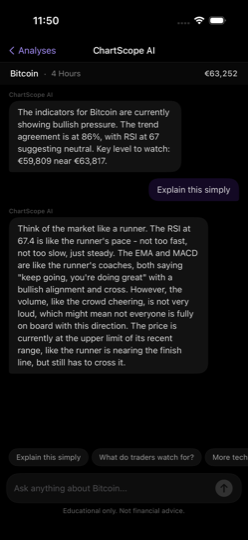
When a user opens a chart in ChartScope, the AI assistant analyzes the visible data and provides educational commentary. It might point out that a particular candlestick formation resembles a known pattern, explain what that pattern has historically indicated, and describe how other technical indicators on the chart support or contradict that interpretation. The goal is always to teach the user how to read the chart themselves, not to tell them what to do.
Education, Not Signals
This distinction is critical. ChartScope does not generate buy or sell signals. It does not predict future prices. It does not tell users when to enter or exit positions. Instead, it explains the educational concepts behind what is happening on a chart so that users can develop their own analytical skills over time. Think of it as having a knowledgeable study partner who can explain any chart pattern or indicator on demand.
ChartScope uses a two-layer AI architecture. Trend classification runs entirely on your device via Apple Core ML — your portfolio data, API keys, and exchange connections never leave your hardware. AI narrative explanations, multi-turn chat, and chart vision analysis use privacy-gated cloud functions that only activate after you explicitly grant consent in the app. Your API keys are stored in the iOS Keychain with hardware encryption and are never transmitted to any server. You can learn about our complete approach to data protection in our support center.
Supported Indicators and Analysis
ChartScope's AI assistant can help learners understand over ten major technical indicators, including RSI, MACD, Bollinger Bands, moving averages, volume analysis, and common chart patterns like head and shoulders, double tops, and support and resistance levels. Each indicator comes with contextual explanations that adapt to the specific chart and timeframe the user is viewing.
By connecting exchange accounts from Binance, Coinbase, or Kraken in read-only mode, users can study their own holdings and learn to apply technical analysis to assets they actually own. This makes the learning process more engaging and immediately relevant compared to studying hypothetical examples.
The Future of AI in Crypto Education
The field of AI crypto trading education is still in its early stages, and the pace of development is accelerating. Several trends are likely to shape the next generation of AI-powered learning tools for cryptocurrency markets.
More Sophisticated On-Device Models
As mobile hardware continues to improve, on-device AI models will become more capable without sacrificing privacy. Future models may be able to perform complex multi-asset correlation analysis, sentiment analysis from market data patterns, and even simulate historical market scenarios for educational purposes, all running locally on a smartphone.
Personalized Learning Journeys
AI will increasingly adapt to individual learning styles and knowledge levels. Rather than offering the same explanation to every user, future systems will build detailed profiles of what each learner knows and tailor every interaction accordingly. A complete beginner asking about RSI would receive a different explanation than an intermediate student who already understands momentum indicators but is learning about divergences.
Interactive Market Simulations
AI-powered simulations will allow learners to practice analysis in realistic but risk-free environments. Imagine being able to "replay" a historical market crash or rally, with an AI assistant explaining what was happening at each stage and why certain technical signals appeared when they did. This experiential learning approach could dramatically accelerate the development of analytical skills.
Cross-Asset and Cross-Market Education
As crypto markets mature, understanding their relationships with traditional financial markets becomes increasingly important. Future AI educational tools will likely help learners understand how cryptocurrency markets interact with equities, commodities, interest rates, and macroeconomic events, providing a more complete picture of the financial landscape.
Voice and Conversational Interfaces
Natural language processing improvements will make it possible to have detailed educational conversations with AI assistants about market analysis. Learners will be able to ask follow-up questions, request deeper explanations of specific concepts, and engage in dialogue-based learning that feels more like working with a personal tutor than using a software tool.
Getting Started with AI-Powered Crypto Education
If you are interested in exploring how AI can accelerate your understanding of cryptocurrency markets, here are some principles to keep in mind as you choose your learning tools.
- Prioritize privacy: Look for tools that process data on-device rather than sending it to the cloud. Your financial data deserves the highest level of protection.
- Seek education over signals: The best AI tools teach you to analyze markets yourself. Be skeptical of anything that promises to tell you what to buy or sell.
- Start with fundamentals: Even with AI assistance, understanding the basics of candlestick charts, volume, and key indicators like RSI and MACD is essential. AI enhances learning but does not skip it.
- Practice with real data: Connecting a read-only exchange account lets you study assets you actually hold, making the learning process more relevant and engaging.
- Stay curious: Markets evolve, and so does AI technology. The tools available today will be significantly more capable in a year, so developing a habit of continuous learning serves you well in both the short and long term.
ChartScope is designed with all of these principles at its core. You can learn more about our approach or explore the app to see how on-device AI makes crypto education more accessible, more private, and more effective.
Important Disclaimer
ChartScope is strictly an educational tool. It does not provide financial advice, investment recommendations, or trading signals. All AI-generated analysis is intended to help you learn about technical analysis concepts, not to guide investment decisions. Cryptocurrency markets are highly volatile and carry significant risk. Always do your own research and consult a qualified financial advisor before making any investment decisions. Past performance of any pattern or indicator does not guarantee future results.